Waking up to coffee that’s already brewed never gets old. A smart coffee maker schedules the brew from your phone and starts it with your voice from bed. In 2026 the category has matured: apps are more reliable, voice control is standard, and a solid smart drip machine costs about the same as a good non-smart one.
This guide covers what matters when choosing one, then lays out five picks — drip, espresso, compact, grinder, and budget. Each is a buying archetype with real criteria, not a paid placement. We earn through Amazon affiliate links, so our only incentive is a machine you’ll like.
Why Go Smart? What the Connectivity Actually Gets You
[IMAGE: buying-factors — phone app scheduling a coffee brew next to the machine | alt: “smart coffee maker app control and scheduling”]
Scheduled brews that fit your routine. Set different brew times for weekdays and weekends, and coffee waits when you get up. The best machines store schedules locally so brewing survives a Wi-Fi drop.
App and voice control. The app adjusts brew strength and keep-warm time and sends descaling and empty-tank alerts. Most machines take Alexa or Google Assistant commands for “start brewing” from bed. Read recent app reviews first — a crashing app is worse than none — and note most machines need 2.4 GHz Wi-Fi, with water and grounds loaded the night before.
The honest bottom line: smart features don’t make bad coffee good — they make good coffee convenient. Pick solid brewing hardware first, and treat connectivity as the tiebreaker.
What to Look for Before You Buy
These six factors separate machines you’ll love from ones you’ll fight with.
1. Brew Type: Drip vs. Espresso
Smart drip brews full pots (10–12 cups) and suits households and black-coffee drinkers — scheduling is most reliable here. Smart espresso pulls shots and steams milk for lattes, but makes one or two drinks at a time and costs more. If you mostly drink drip, a drip machine plus a handheld frother beats a budget espresso machine for the occasional latte.
2. Scheduling and App Reliability
Look for multiple schedules, remote start, and maintenance reminders, with schedules stored locally so a Wi-Fi outage doesn’t cancel your brew. Skim recent app reviews — this is where smart coffee makers succeed or fail.
3. Milk Frothing
Espresso machines include a steam wand (more control, small learning curve) or an automatic frother (push-button, less control). Some drip machines bundle a standalone frother. A wand makes better microfoam once learned; neither option turns a drip machine into an espresso machine.
4. Built-in Grinder
Fresh-ground beans make a real difference. Insist on a burr grinder over blade, check the grind settings, and read reviews for noise — a loud grinder at 6 a.m. defeats scheduled brewing. Confirm the burrs are accessible and the machine accepts pre-ground coffee.
5. Water Tank Capacity and Filtration
A larger, removable reservoir means fewer refills — critical for overnight brews. It should be transparent or clearly marked, and built-in filtration improves taste while slowing scale buildup.
6. Size and Counter Space
Measure your counter including clearance under cabinets — some machines need the lid fully open to fill. Compact machines suit apartments; full-size drip and grinder models can dominate a small kitchen. Also note cord length and exit side.
Our Top 5 Picks for 2026
Each pick describes its slot and what to look for.
Best Overall Smart Drip: Hamilton Beach 49350R (Works with Alexa)
ASIN: B09WW5691Q
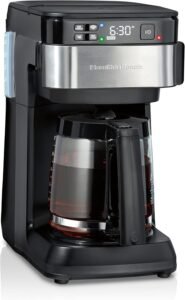 This is the pick for most people, and it earns the “smart” label the honest way: the Hamilton Beach 49350R is “Works with Alexa” certified, so there’s no extra app to install — scheduling runs through Alexa Routines (different weekday/weekend brews, remote start from your phone), and one voice command starts a brew. You get a full 12-cup pot, regular/bold brew-strength control, and a front-fill reservoir you can top up without pulling the machine out.
On hardware: it uses a glass carafe on a keep-warm hot plate rather than a thermal carafe — fine for households that drink the pot within the hour, less ideal if coffee sits all morning (glass on heat can taste scorched over time). Brewing temperature holds well through the whole pot, and as a major-brand machine with years of sales history, long-term reliability and parts support beat most budget smart brewers.
- Pros: Full pot for households; Alexa-native scheduling and voice (no extra app); front-fill reservoir; best value per cup.
- Cons: Largest footprint; glass carafe (not thermal) can taste scorched if left on heat too long; no espresso or milk drinks.
Best for: Households that drink multiple cups of regular coffee daily.
Best Smart Espresso: De’Longhi Dinamica Plus Connected
ASIN: B08TGCTT6C
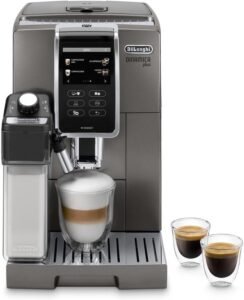
If your daily drink involves steamed milk, this is your category — and the honest pick here is a super-automatic, not a portafilter machine. The De’Longhi Dinamica Plus grinds, brews, and froths at the touch of a button: a 19-bar pump, a built-in conical burr grinder, and the LatteCrema system that textures milk automatically for lattes and cappuccinos. There is no portafilter to dose and no steam wand to master — the machine handles the craft end to end.
The smart features are drink-focused: the Coffee Link app saves your custom recipes, stores up to three user profiles (so everyone’s drink is one tap away), and sends descaling and maintenance alerts. That automation is the point — and the trade-off. Espresso hobbyists who enjoy dialing in grind and dose will find a super-automatic less hands-on than a semi-automatic machine, and at around $1,300 this is the priciest pick in the guide by far. But for push-button lattes that beat the café line, nothing else here comes close.
- Pros: True one-touch lattes and cappuccinos; built-in grinder; app saves custom drinks per user; far cheaper per drink than cafés.
- Cons: Premium ~$1,300 price; no portafilter or manual control for hobbyists; daily cleaning of the milk carafe and drip tray.
Best for: Daily latte, cappuccino, or flat white drinkers who want café drinks with zero technique.
Best Compact: Keurig K-Supreme Plus SMART
ASIN: B0973YH74Z
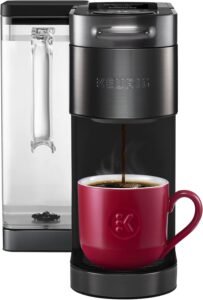 Small kitchens, dorms, and offices need a machine that doesn’t eat the counter, and single-serve is the smallest brewer class there is. The Keurig K-Supreme Plus SMART brings BrewID pod recognition (it tunes the brew to the specific K-Cup), MultiStream brewing, and a 78 oz removable reservoir — big for a compact machine. The Keurig app handles scheduling, remote brew, and saved favorites, and starting a brew from your phone while you get ready is arguably more valuable in a tight space.
Two honest caveats. First: there’s no Alexa or Google voice control here — it’s app-only, so don’t buy it for voice start. Second: K-Cups are a proprietary format that locks you into Keurig’s ecosystem and raises the long-term per-cup cost versus ground coffee. The tradeoff on capacity stands too: single-serve is perfect for one or two drinkers but tedious for a household. Also confirm the height with the lid open fits under your cabinets — a common surprise in small kitchens.
- Pros: Fits anywhere; app scheduling and remote brew; BrewID tunes each pod; large 78 oz reservoir for the size.
- Cons: No voice control (app only); proprietary K-Cup pods raise per-cup cost; single-serve only.
Best for: Apartments, dorms, offices, and single drinkers short on counter space.
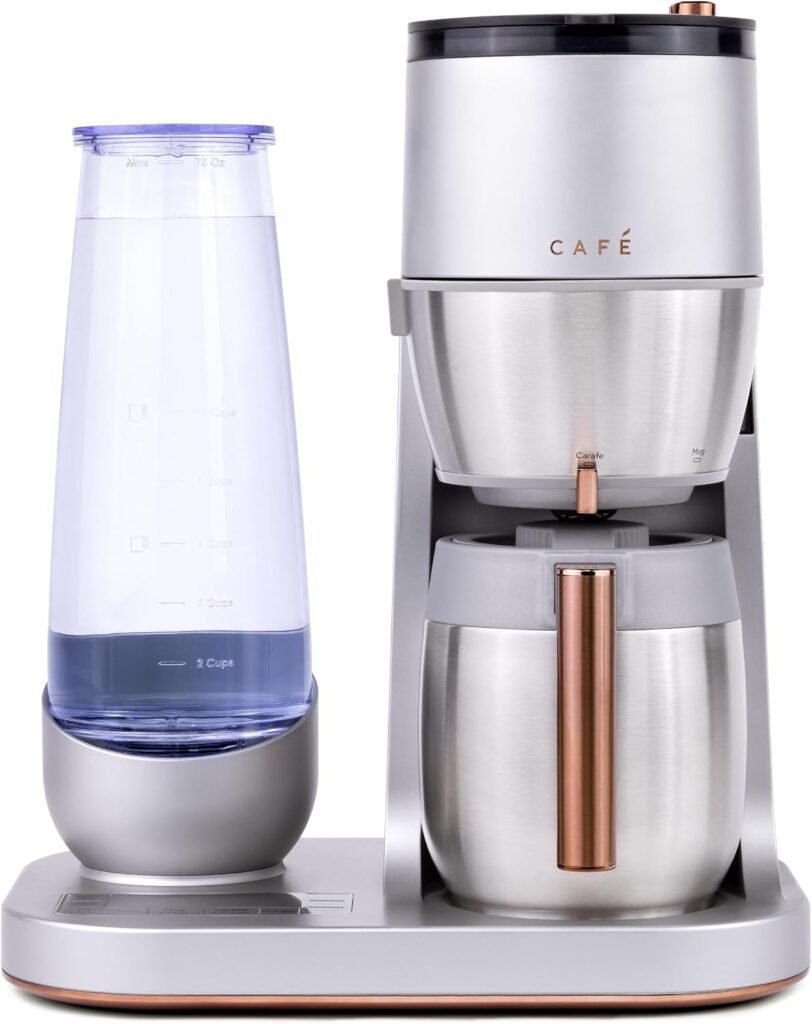
Best with Grinder: Café Specialty Grind and Brew (C7CGAAS2TS3)
ASIN: B0CG2P2J88
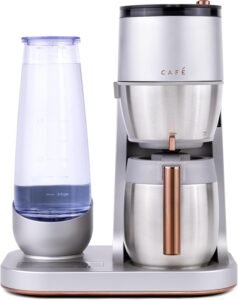 Grinding right before brewing is the single biggest upgrade most coffee drinkers can make, and the Café Specialty Grind and Brew removes the extra appliance: a true conical burr grinder (6 settings) built into a WiFi-connected 10-cup brewer. It’s SCA Gold Cup certified for brewing temperature, uses a thermal carafe instead of a hot plate, and the SmartHQ app covers remote brew, scheduling, strength and temperature control, plus Alexa/Google voice. It also accepts pre-ground coffee as a bypass when you don’t want to grind.
Noise matters more here than anywhere else — check owner reviews specifically for early-morning noise complaints, since a loud grinder undermines scheduled pre-dawn brewing. Also note this is a premium pick (around $279–$329) with a smaller owner base than the budget options, so read recent reviews carefully. On the plus side, the burrs are accessible for cleaning and the hopper seals against air.
- Pros: Freshest cup, no extra appliance; true burr grinder; thermal carafe; SCA certified; voice + app control.
- Cons: Loudest category; premium price; smaller review base — check recent owner feedback.
Best for: Whole-bean buyers who want the freshest cup with the least fuss.
Best Budget Smart: Atomi Smart WiFi Coffee Maker (AT1317)
ASIN: B07NVRXTGG
[IMAGE: product-5 — Atomi smart WiFi coffee maker brewing into glass carafe | alt: “Atomi smart WiFi coffee maker budget pick 2026”]
You don’t need to spend a lot for the core smart experience. The Atomi AT1317 is the consensus budget pick: a 12-cup drip machine with WiFi, daily/weekly scheduling and remote brew in the Atomi Smart app, coffee-ready alerts, Alexa and Google voice control, and regular/strong brew — typically around $55–$90, the cheapest entry to real smart brewing.
What gets cut at this price: thermal carafe (expect glass on a hot plate), built-in grinder, fancy displays, premium materials. None of those affect the core job of brewing scheduled coffee. Two things to know: some owners report occasional WiFi reconnect hiccups — worth a glance at recent reviews — and budget models can see shorter app-support windows, so confirm the app is still actively maintained.
- Pros: Smart brewing under $150 (often under $90); scheduling, app, and voice included; great gift option.
- Cons: Basic materials and glass carafe; occasional WiFi reconnect reports; shorter app support on budget models.
Best for: First-time buyers, gifts, and anyone wanting scheduled coffee without overthinking it.
Quick Comparison
[IMAGE: comparison — five coffee makers side by side on a counter | alt: “smart coffee maker comparison 2026 drip espresso compact grinder budget”]
| Pick | Brew type | Capacity | Key strength | Watch out for |
|---|---|---|---|---|
| Hamilton Beach 49350R (Best Overall) | Drip | 12 cups | Alexa-native scheduling + voice, best household value | Glass carafe, not thermal |
| De’Longhi Dinamica Plus (Best Espresso) | Super-automatic espresso | 1–2 drinks | One-touch lattes, app recipes, built-in grinder | ~$1,300; no manual control |
| Keurig K-Supreme Plus SMART (Best Compact) | Single-serve | 1 cup | Fits anywhere, app scheduling + remote brew | App only (no voice); K-Cup lock-in |
| Café Grind and Brew (Best with Grinder) | Drip | 10 cups | Freshest cup; burr grinder; SCA certified | Premium price; smaller review base |
| Atomi AT1317 (Best Budget) | Drip | 12 cups | Core smart features, often under $90 | Basic materials; occasional WiFi hiccups |
Who Should Skip a Smart Coffee Maker?
Pour-over and French press devotees won’t gain much — if you enjoy the manual ritual, automation removes the part you like. If your Wi-Fi is unreliable, the headline features turn intermittent. Espresso purists chasing café-grade shots may do better with a non-smart machine with better hardware. And one-cup-a-day drinkers get most of the convenience from a simple programmable machine for less.
Frequently Asked Questions
What is a smart coffee maker?
A smart coffee maker is a drip or espresso machine with Wi-Fi and a companion app for scheduling brews, remote start, settings like brew strength, and maintenance alerts. Most also work with Alexa or Google Assistant for voice-controlled brewing.
Do smart coffee makers work with Alexa?
Most do — Alexa is the most common integration, and many also support Google Assistant. You can typically start or stop brewing by voice; finer controls like per-command strength changes are less common.
Are smart coffee makers worth it?
Yes, if you’ll use scheduling and voice control daily. The coffee tastes like what the hardware can produce — smart features don’t fix a bad brewer. Rare timer users get better value from a standard programmable machine.
Can you schedule a smart coffee maker to brew?
Yes — scheduling is the core feature. Most apps support different brew times per day, and many machines store schedules locally so brewing continues during Wi-Fi outages. Load water and grounds or a filter the night before.
Do smart espresso machines make good espresso?
They can, within home-equipment limits. Proper pump pressure and temperature control pull respectable shots and decent milk. But smart features don’t improve extraction — grind, dose, and tamp technique still matter. If espresso quality is the top priority, rank brewing hardware above app features.
How much does a smart coffee maker cost?
Smart drip runs under $150 (budget) to $200–$300 (full-featured). Smart espresso starts around $300 and climbs. Compact single-serve brewers typically sit in the $100–$200 range.
Do smart coffee makers need Wi-Fi to work?
Only for app control, voice commands, and remote schedule changes. Most still brew manually when Wi-Fi is down, and many keep stored schedules running locally — check a model stores schedules on the machine itself.
The Bottom Line
Match the machine to your habits: households that run through a pot a day want a reliable smart drip machine; latte drinkers need a smart espresso machine with a capable frother; small spaces call for compact; bean lovers should get the grinder; everyone else can get scheduled, voice-controlled coffee for under $150.
Apply the same test to any model: solid brewing hardware first, a well-reviewed app second, voice control as the tiebreaker. Do that and you’ll still be happy two years from now.
Ready to choose? Check current prices on our top picks above — prices shift often, so the links always show the latest. Happy brewing.
Disclosure: SmartGagetz.com is reader-supported. When you buy through links on this page, we may earn an affiliate commission at no extra cost to you.