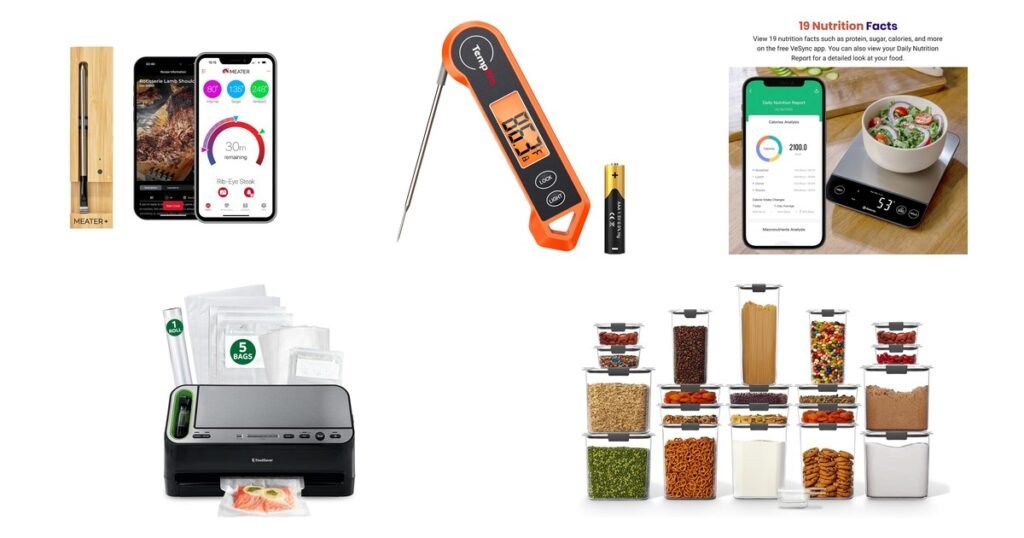
If you cook meat more than twice a month, a reliable kitchen thermometer is the single highest-value gadget you can own. Not a new pan. Not a knife set. A thermometer. It is the difference between a dry chicken breast and a juicy one, between guessing and knowing, and — for poultry and ground meat — between dinner and a food-safety gamble.
This guide covers the full precision toolkit: thermometers first, then the supporting cast — an app-connected kitchen scale, a vacuum sealer, and smart food storage. Each pick is an archetype based on specs, buyer feedback, and value, with honest trade-offs so you buy right the first time.
Why precision matters in your kitchen
Food safety is not negotiable. Color is a terrible doneness indicator — ground beef can look done at unsafe temperatures. The USDA publishes minimum internal temperatures for a reason. A thermometer is the only way to verify you hit them.
Perfect results are repeatable results. The best steak you ever made was not luck — it was a temperature. Medium-rare is 130–135°F on Tuesday or at a dinner party. Cook by temperature instead of time, and every recipe becomes reproducible.
Less waste, more money saved. Overcooked meat gets thrown away; freezer-burned bulk buys go in the trash. A thermometer, a scale, and a vacuum sealer form a chain: cook it right, portion it right, store it right. For a household that cooks regularly, that chain pays for itself many times over.
What to look for before you buy
[IMAGE: buying-factors — thermometer probe, scale display, vacuum sealer bags | alt: “what to look for in the best kitchen thermometer 2026”]
1. Accuracy and calibration
Accuracy is the whole point. Most decent digital thermometers claim accuracy within ±1–2°F, which is plenty for home cooking. What matters more is whether the thermometer stays accurate. Look for models that support recalibration — typically via an ice-bath test (should read 32°F). If a thermometer cannot be recalibrated, treat it as disposable: fine at a low price, frustrating at a premium one.
2. Read speed and response time
Instant-read thermometers should stabilize in a few seconds — fast enough that you are not holding the oven door open. Leave-in probe thermometers are a different tool: they sit in the meat for the whole cook and report continuously, so connection stability matters more than response time. Decide which job you need done before you shop, because one tool rarely does both well.
3. Wireless range and app features
Wireless thermometers come in two flavors: Bluetooth (shorter range, simpler, cheaper) and Wi-Fi (longer range, monitor from anywhere). Bluetooth is fine if you stay near the kitchen; Wi-Fi earns its premium if you want alerts from the yard. App quality varies enormously — check recent app-store reviews. A thermometer with a great probe and a crashing app is a bad thermometer.
4. Probe and sensor durability
Probes live a hard life: high heat, moisture, repeated washing. Look for heat-resistant cables on leave-in models and waterproof or splash-proof ratings (IP65/IP67 is common on good instant-reads). Dishwasher-safe is a bonus — hand-washing a probe takes ten seconds. Never submerge a transmitter or battery housing unless the manual explicitly allows it.
5. Scale precision, capacity, and units
A kitchen scale needs 1-gram (0.1 oz) resolution, a tare/zero function, and at least 5 kg / 11 lb capacity. App-connected “nutrition” scales add macro and calorie estimates via a food database — useful if you track macros, gimmicky if you do not. Check that the app’s database covers what you eat, and that the scale works fine as a plain scale if you ever abandon the app.
6. Sealer suction power and ongoing bag cost
Vacuum sealers are judged on seal reliability more than suction numbers — a weak seal that fails in the freezer is worse than no sealer at all. External clamp-style sealers are affordable and handle dry goods and sous vide prep well; chamber sealers cost far more. Budget for bags: proprietary rolls are a recurring cost, so check per-bag pricing and third-party compatibility first.
7. Storage footprint and counter reality
Thermometers and scales are small; vacuum sealers are not. Measure your storage before buying a sealer — many end up in a cabinet and never get used because dragging them out is a chore. If counter space is tight, a compact sealer you can store vertically, plus stackable airtight containers for everyday leftovers, beats a “better” sealer that lives in the garage.
Our top 5 picks for 2026
1. Best Wireless Smart Meat Thermometer: MEATER Plus
ASIN: B07H8WTFHW
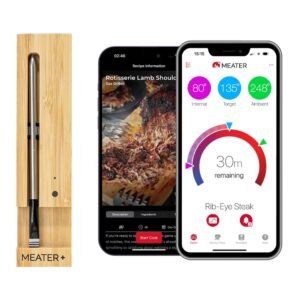 This is the pick for anyone who grills, smokes, or roasts regularly and hates hovering. The MEATER Plus is a 100% wire-free leave-in probe — no cables at all — with dual sensors tracking both meat and ambient temperature, sending live readings to your phone over an extended 165 ft wireless range. Set a target, walk away, and get an alert when it is time to pull.
In our research, the models buyers keep longest share three traits: stable connectivity (dropped signals mid-cook are the top complaint in this category), probes rated for genuine high heat, and an app that does not require a subscription for basic alerts. The MEATER app adds a guided cook system that walks you through rests and target temps — genuinely useful, not a gimmick. With around 48,000 owner ratings, it’s the most proven wire-free thermometer on Amazon.
- Pros: completely wire-free; dual meat + ambient sensors; guided cook system; ideal for smoking and long roasts
- Cons: more expensive than instant-reads; Bluetooth range can disappoint through thick walls
- Best for: grillers, smokers, and anyone who cooks large cuts regularly
2. Best Instant-Read Thermometer: ThermoPro TP19H
ASIN: B07XXSYLL8
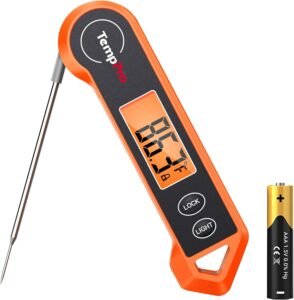 If you buy exactly one item from this guide, make it this one. The ThermoPro TP19H gives you a fast, accurate temperature in 1–3 seconds — for steaks, chicken, pork chops, bread, frying oil, and candy — with a backlit display that auto-rotates 180° so you can read it at any angle under a range hood. It is the tool professional cooks reach for most, and it costs less than a takeout dinner. With 50,000+ owner ratings at 4.7 stars, it’s one of the most trusted thermometers on Amazon.
What separates good from great: reading speed, a display you can read at a glance, and a probe thin enough not to shred delicate food. The TP19H is waterproof (this is the thermometer you will wash constantly), folds shut to protect the probe in a drawer, and has a magnetic back that sticks it to the oven or fridge.
Skip the gimmicks: you do not need a talking thermometer or a “smart” instant-read that adds an app to a five-second task.
- Pros: affordable; 1–3 second readings; waterproof; foldable probe; magnetic back; no app drama
- Cons: cannot monitor a whole cook unattended; you open the oven/grill to check
- Best for: every home cook — the baseline tool the rest of this guide builds on
3. Best App-Connected Nutrition / Kitchen Scale: Etekcity Smart Scale
ASIN: B07FCZSC41
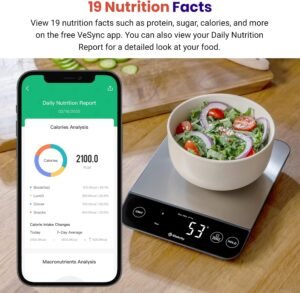 Baking is chemistry, and chemistry needs a scale: 1-gram resolution, a tare button, and units that switch between grams, ounces, milliliters, and pounds. The Etekcity Smart Food Kitchen Scale meets that bar — then adds the differentiator: the VeSync app with a 19-nutrient tracker (Nutritionix food database) that logs weight, calories, and macros as you weigh. Genuinely useful if you meal-prep or track protein, with around 8,700 owner reviews.
The honest caveat: the hardware here is largely commoditized — the app is the product. Check that the food database covers what you eat, and note this scale works fine as a plain scale with the app deleted — as it should; if a smart scale doesn’t, walk away.
For pure bakers who do not track macros, a simpler non-connected scale at half the price does the identical weighing job. Buy the app version only if you will use the app weekly.
- Pros: 1g precision for baking; macro/portion tracking for meal prep; tare function and multi-unit display
- Cons: app quality varies; nutrition databases can be US-centric; premium over basic scales
- Best for: bakers, meal-preppers, and macro trackers
4. Best Vacuum Sealer: FoodSaver V4400 2-in-1
ASIN: B00DI342B4
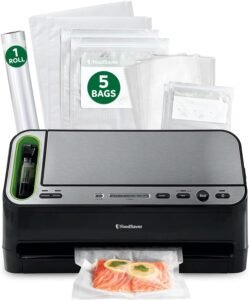 A vacuum sealer removes air from bags before sealing, which slows freezer burn and oxidation dramatically. The FoodSaver V4400 2-in-1 is the proven pick: an external clamp sealer with automatic bag detection, a “moist” mode for juicy foods, built-in roll storage and cutter, compatibility with standard third-party bag rolls (keeping running costs down), and a 5-year warranty. Around 10,377 owner ratings at 4.6 stars.
An honest pricing note: this sits upper-mid (roughly $117–$200 depending on sales), not budget — you’re paying for the automatic moisture detection and the warranty. If that’s more sealer than you need, FoodSaver’s simpler models cost less, but the V4400 is the one buyers keep longest.
The main reason sealers get abandoned is friction: if yours is buried in a cabinet, you will not use it. Store it within reach, keep bags beside it, and it becomes a habit. If you rarely freeze food in bulk, skip this pick — airtight containers (pick 5) cover daily leftovers better.
- Pros: dramatically extends freezer life; automatic moisture detection; 5-year warranty; great for sous vide and bulk buying
- Cons: upper-mid price; counter/cabinet footprint; ongoing bag cost
- Best for: bulk buyers, sous vide cooks, and serious meal-preppers
5. Best Smart Food Storage Set: Rubbermaid Brilliance 20-Piece
ASIN: B0B1KRGD3Q
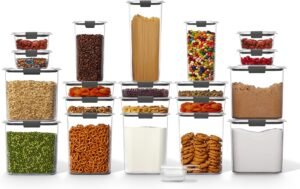
Not everything needs vacuum-sealing. For daily leftovers, prepped ingredients, and pantry staples, the Rubbermaid Brilliance 20-piece set does more day-to-day work than any other pick here: airtight latched lids with a positive seal, stackable shapes that nest, BPA-free Tritan construction, and full dishwasher/microwave/freezer tolerance. Around 30,893 owner ratings at 4.8 stars make it one of the most trusted storage sets on Amazon.
One material note: this is Tritan plastic, not glass. It’s stain- and odor-resistant for a plastic (a real step up from cheap containers that go cloudy and tomato-stained), but if you store a lot of curries and tomato sauces and want maximum stain resistance, a glass set is the premium alternative. For most households, the Brilliance hits the sweet spot of airtight, lightweight, and genuinely dishwasher-proof.
Prioritize: lids that seal with a positive latch (these do), and sizes covering both single portions and family batches — this 20-piece set includes scoops and covers both.
- Pros: daily-use workhorse; airtight latched lids; stackable and dishwasher-safe; no ongoing costs; 30,893 ratings
- Cons: Tritan plastic, not glass (glass resists stains better); not a substitute for vacuum sealing long-term freezer storage
- Best for: everyone — meal prep, leftovers, pantry organization, lunch packing
[IMAGE: comparison — all five product categories side by side | alt: “kitchen thermometer scale sealer comparison 2026”]
Quick comparison
| Pick | Category | Best for | Approx. price tier | Key strength |
|---|---|---|---|---|
| MEATER Plus (Wireless Thermometer) | Leave-in probe + app | Grilling, smoking, roasts | $$–$$$ | Wire-free monitoring with guided cook |
| ThermoPro TP19H (Instant-Read) | Handheld probe | Everyday cooking | $ | 1–3 sec readings, waterproof, no-fuss |
| Etekcity Smart Scale (App Scale) | Scale + nutrition app | Baking, meal prep, macros | $$ | 1g precision + food logging |
| FoodSaver V4400 (Vacuum Sealer) | External clamp sealer | Bulk freezing, sous vide | $$–$$$ (upper-mid) | Moisture detection, 5-yr warranty |
| Rubbermaid Brilliance 20pc (Storage) | Airtight containers (Tritan) | Daily leftovers & pantry | $–$$ | Everyday airtight organization |
Price tiers are relative ($ = budget-friendly, $$$ = premium).
Who should skip this gear
- Rare cooks: if you cook meat a few times a year, a basic instant-read is the entire purchase. The rest of this guide is for regulars.
- App skeptics: if you will never open a companion app, buy non-connected versions — a plain instant-read and basic scale do the core jobs identically.
- Tiny kitchens: a vacuum sealer you cannot store accessibly is one you will not use. Start with the storage set.
- Sous-vide-only shoppers: the vacuum sealer (pick 4) jumps to the top of your list — it is the natural companion tool.
FAQ
What is the most accurate kitchen thermometer?
For home use, a quality digital instant-read or calibrated leave-in probe reading within ±1–2°F is as accurate as you need. Calibration matters more than the spec sheet — a recalibratable thermometer stays trustworthy for years.
What’s the difference between an instant-read and a leave-in thermometer?
An instant-read is a handheld probe you insert for a few seconds to spot-check. A leave-in probe stays in the food for the whole cook and reports continuously, often to your phone. Many serious cooks own both.
Are wireless meat thermometers worth it?
If you grill, smoke, or roast large cuts regularly — yes: set a target, get an alert, stop hovering. For weeknight chicken breasts and steaks, an instant-read covers you for less.
How do I calibrate a food thermometer?
The ice-bath method: fill a glass with ice, add cold water, stir, insert the probe without touching the sides — it should read 32°F (0°C). If your thermometer supports recalibration, adjust per its manual; if not and it’s off by more than 2–3°F, replace it.
What temperature should chicken be cooked to?
165°F (74°C) internal temperature for all poultry, per USDA guidance — measured in the thickest part. Whole cuts of beef, pork, lamb, and fish need 145°F plus rest; ground meats need 160°F. When in doubt, thermometer beats memory.
Do I need a kitchen scale for baking?
If you bake more than occasionally, yes. Cups vary by how you scoop; grams do not. A scale is also the fastest way to portion meal prep — the cheapest accuracy upgrade in this guide.
Is a vacuum sealer worth it for a home kitchen?
It is worth it if you freeze food in bulk, buy meat on sale, or cook sous vide — the reduction in freezer burn alone justifies it for those households. If you mostly refrigerate leftovers for a day or two, airtight containers do the job.
The bottom line
Start with the instant-read — inexpensive and indispensable. Add the wireless thermometer when you cook cuts worth monitoring, the scale when baking or meal prep gets serious, and the sealer plus storage set when you are ready to stop throwing food away.
Precision is not fussy cooking. It is the shortest path to food that tastes the way you intended, every time — and to a kitchen that wastes less.
Ready to upgrade? Browse our top picks above — every link goes to Amazon with our reader-supported affiliate tag, which keeps SmartGagetz’s guides free. Prices change daily, so check the live listing before you buy.
Affiliate disclosure: As an Amazon Associate, SmartGagetz earns from qualifying purchases. Product recommendations are based on independent research of specs and buyer feedback; we do not accept payment for placements. Prices, ratings, and availability were not live-verified at draft time — please confirm on Amazon before purchasing (tag: smartgagetz01-20).