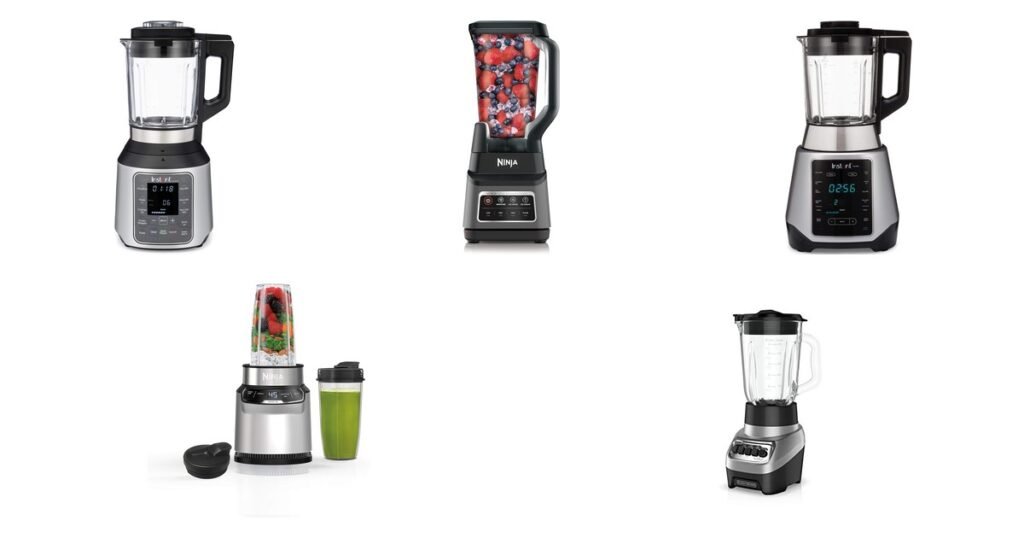
If you have ever scraped frozen mango off a blender blade at 7 a.m., you know the gap between what a blender promises and what it does. The best smart blender of 2026 tries to close that gap — not with gimmicks, but with features that remove the annoying parts of blending: one-touch presets that time the blend correctly, self-cleaning cycles that rinse the jar for you, heating elements that turn raw vegetables into hot soup, and companion apps with guided recipes.
This guide explains what “smart” means on a blender in 2026, which features are worth paying for, and which five blender types suit different households — no hype, no invented scores.
Why Go Smart? What These Features Actually Do
Self-cleaning cycles. Add warm water and a drop of dish soap, press clean, and the blender runs a high-speed rinse that handles roughly 90% of daily cleanup. An occasional deep clean is still needed, but for daily smoothies it genuinely saves time.
Heating function. Some full-size models include a heating element in the jar base: blend raw vegetables with broth, run the soup program, and the machine cooks and blends in one cycle. It will not replace your stove, but it removes a pot from soup night.
Smoothie and food presets. Press “Smoothie” or “Frozen Dessert” and the blender runs a timed program with automatic speed changes. Good presets produce smoother results than manual blending because they pulse, ramp, and rest the motor at the right moments.
App recipes and control. Companion apps offer guided recipes, nutrition estimates, and remote start/stop. The recipes can help beginners, but app control itself is a nice-to-have — nobody’s morning improves because they started a smoothie from the couch.
What to Look for: 7 Buying Factors That Actually Matter
1. Motor Power
Motor power decides what the blender handles without straining. Fresh-fruit smoothies are fine on moderate power; regular frozen fruit, ice, or nuts call for a stronger full-size motor that runs cooler and lasts longer. On personal-size models, confirm frozen blending is explicitly supported rather than assuming it.
2. Jar Capacity and Material
Match the jar to your household: a large family-size jar suits soups and batch smoothies, while a single-serve cup blends small volumes better. Glass resists odors and staining but is heavy; BPA-free Tritan plastic is lighter and shatter-resistant. For heating models, confirm the jar is rated for hot liquids.
3. Preset Programs
Check which presets you actually get. The useful core is smoothie, frozen dessert/ice crush, soup (on heating models), and self-clean. A pulse function and manual variable-speed control matter too — presets are great until you want something slightly different.
4. Self-Cleaning
Verify the cleaning cycle is a real programmed routine, not just a “clean” label on a manual high-speed button. Also check whether the blade assembly is removable and parts are dishwasher-safe — the self-clean cycle handles daily rinses, not weekly deep cleans.
5. Heating / Soup Function
A proper soup cycle both cooks and blends; weaker implementations merely warm pre-cooked ingredients. If you only want cold drinks, skip the heating element and put the money toward a better motor or quieter operation.
6. Noise Level
No full-size blender is silent, but heavier bases, dampened housings, and efficient preset programs make some models noticeably more tolerable. If you blend before the house wakes up, check user feedback specifically about morning noise.
7. App Connectivity
Treat the app as a bonus. Useful: guided recipes and preset updates. Red flags: an app required for core functions, or one with consistently poor reviews. If you do not care about recipes, a model with great presets and no app is often the better buy.
Our Top 5 Picks: The Best Smart Blender Types of 2026
Rather than pushing specific brand names, we recommend by archetype — the five configurations that cover nearly every kitchen. When you shop the links below, match the archetype to models with strong recent ratings and verified purchase reviews.
Best Overall: Instant Pot Ace Nova Cooking Blender
ASIN: B07VMTWHQK
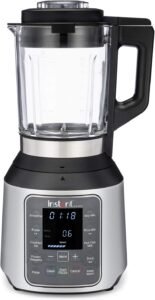 This is the do-everything countertop model: the Instant Pot Ace Nova pairs a strong motor and large family-size jar with a concealed heating element, 8–10 smart programs (Smoothie, Crushed Ice, Frozen Desserts, Nut/Oat Milk, Soy/Rice Milk, Purée, Soup), a Clean program, a tamper, real-time temperature display, and keep-warm. It is the pick for the household that wants one blender to handle morning smoothies, weeknight soups, and frozen desserts.
The appeal is balance: the motor handles frozen fruit and ice without bogging down, the presets are well-timed, and the heating function is the differentiator — tomato soup from raw ingredients in one jar. The free Instant Pot recipe app exists, but treat the app as a bonus: there’s no remote start/stop of the blender, so buy it for the programs, not the phone.
Two honest notes. First, the trade-offs are size, noise, and price: a real countertop footprint, typical blender volume, and a premium price tier. Second, availability: some retailers cleared the Ace Nova in 2026, which can signal a model nearing end-of-life — confirm the Amazon listing is live and in stock before you buy, since a dead listing is the one real risk here.
Pros:
– Handles smoothies, frozen drinks, hot soups, and sauces
– Well-timed presets plus manual speed control
– Self-cleaning cycle makes daily use low-effort
– Heating element removes a pot from soup night
Cons:
– Large countertop footprint
– Loud, like all full-power blenders
– Premium price; app adds little after the novelty fades
– Possible end-of-life — verify the listing is live
Best for: Daily smoothie drinkers who also want hot soups and sauces from one machine.
Best for Smoothies: Ninja BN701 Professional Plus
ASIN: B0855B5Z6F
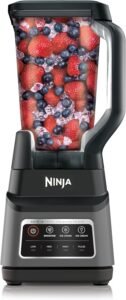
If 90% of your blending is smoothies, buy the blender optimized for smoothies. The Ninja BN701 Professional Plus centers on Auto-iQ: three presets (smoothies, frozen drinks, ice cream) that pulse, ramp, and rest the 1400-peak-watt motor to break down frozen fruit and leafy greens into a silky texture — plus a 72 oz family pitcher. With roughly 37,000 owner ratings, it has the strongest review base of any pick in this guide.
The case for a smoothie specialist is texture: generic blenders leave fibrous kale bits and half-blended chunks, while a well-tuned program does not. Efficient programs also tend to run quieter than brute-force models.
What you give up is versatility: no heating element (cold drinks only — matches this slot), and parts clean in the dishwasher rather than through a dedicated self-clean cycle. No tamper is included either. A fine trade if your stove already handles soup night.
Pros:
– Silkiest smoothie texture from tuned Auto-iQ programs
– Handles frozen fruit, ice, and leafy greens well
– Often quieter than full-power generalists
– Huge owner base (~37,000 ratings)
Cons:
– No heating function — cold drinks only
– Jar sized for drinks, not batch cooking
– No dedicated self-clean cycle (dishwasher-safe parts instead)
Best for: Households where the blender’s main job is daily smoothies and frozen drinks.
Best Heating / Soup Blender: Instant Pot Ace Plus
ASIN: B07Q1JRT7X
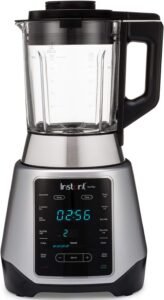 This is the pick for cooks. The Instant Pot Ace Plus runs 10 one-touch programs on a 1300W base with a 54 oz glass pitcher — and its soup program genuinely cooks: it boils, then gently stirs, which is the “real simmer, not just warming” bar a heating blender has to clear. Add chopped raw vegetables and broth, press a button, and the machine cooks and blends in one cycle, pouring hot soup straight from the jar.
Beyond soup, it earns its keep with cheese sauces, tomato sauces, baby food, and warm nut milks — arguably the most versatile appliance in this guide. An auto-clean function handles the daily rinse.
Honest caveats: heating models cost more, jars are heavier, and hot-liquid safety rules apply (never overfill, vent properly, cool slightly before opening). Availability is the real watch-item here — the Instant blender line shows end-of-life signals and at least one reseller has delisted this model, so confirm the Amazon listing is live before you buy. And a category truth worth stating: Instant Pot is the only major brand making true heating blenders for the US market — there is no credible non-Instant alternative, which is why both heating picks in this guide carry the name.
Pros:
– Cooks and blends hot soup in a single jar
– Great for sauces, baby food, and warm drinks
– Doubles as a capable cold-drink blender
Cons:
– Highest price tier in this guide
– Heavier jar; hot-liquid safety rules apply
– Availability uncertain — verify the listing is live
Best for: Home cooks who want weeknight soups, sauces, and baby food with minimal cleanup.
Best Compact / Personal: Ninja Nutri-Blender Pro (BN401)
ASIN: B08QXJ31WR
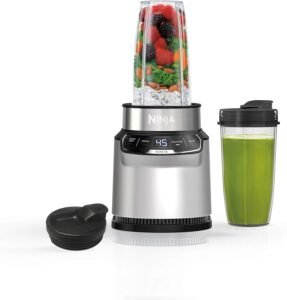 The compact smart blender is a single-serve machine — blend directly in a travel cup, grab it, and go — and the Ninja Nutri-Blender Pro (BN401) nails the formula: an 1100-peak-watt motor, 2 Auto-iQ one-touch presets, Pro Extractor Blades, two 24 oz blend-and-go cups with spout lids, and auto shut-off. It is the right pick for apartments, dorms, offices, and anyone whose blending life is one smoothie at a time.
The strength is fit: small footprint, simple cleanup (the cup is the jar), and enough power for daily smoothies. Good auto programs matter more at this size, since a single-serve cup leaves less room to fix a bad blend.
The limits are real: small motors work hard on fully frozen fruit and ice, so check frozen-blending support explicitly. No heating, no batch cooking — buy this for personal daily use, not a family of five.
Pros:
– Tiny footprint; ideal for small kitchens and offices
– Blend-and-go travel cup design
– One-touch presets tuned for single servings
– Most affordable entry into smart blending
Cons:
– Works hard on heavy frozen loads vs. full-size models
– No heating or batch-cooking capability
– Single-serve only
Best for: Solo smoothie drinkers, apartments, dorms, and office kitchens.
Best Budget: BLACK+DECKER PowerCrush (BL1200)
ASIN: B07RQVL8D5
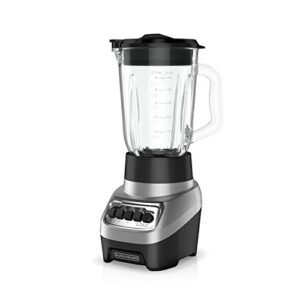 The budget pick proves you do not need premium money for the smart features that matter. The BLACK+DECKER PowerCrush (BL1200 series, 6-cup glass jar) keeps the essentials — Smoothie, Icy Drink, and Purée presets, an Ice Crush function, manual Low/Hi/Pulse, and a dedicated Easy Clean function — while skipping the app, the heating element, and designer styling. Typically around $40–$60.
One honest distinction, straight from the product manual: “Easy Clean” is a labeled function button (run it 10–15 seconds with soap and water), not a timed automatic self-cleaning program. That’s exactly the “clean label vs. real cycle” difference our buying guide warns about — it still makes cleanup easy, just don’t expect a fully automatic cycle.
Budget models cut costs somewhere — usually motor longevity under heavy frozen loads, jar material, or warranty length. For a few smoothies a week, that trade is reasonable; for heavy daily frozen blending, the Best Overall pick pays for itself in lifespan.
Pros:
– Core smart features (presets, clean function) at an accessible price
– Handles everyday smoothies and frozen drinks well
– Simple controls; no app required
Cons:
– No heating function or app recipes
– A step below premium models on motor and warranty
– Not ideal for heavy daily frozen blending
Best for: Moderate-use households that want smart conveniences without the premium price.
Comparison Table: All 5 Picks at a Glance
| Pick | Jar style | Key features | Self-cleaning | Heating | App | Typical price tier |
|---|---|---|---|---|---|---|
| Instant Pot Ace Nova (Best Overall) | Large family-size | Full presets, strong motor, heating | Yes | Yes | Recipe app (no remote start) | Premium |
| Ninja BN701 (Best for Smoothies) | Drink-size / large | Auto-iQ smoothie + frozen presets | Dishwasher parts | No | No | Mid-premium |
| Instant Pot Ace Plus (Best Heating / Soup) | Large, heat-rated | Cook-and-blend soup program | Yes | Yes | No | Premium |
| Ninja Nutri-Blender Pro (Best Compact) | Single-serve travel cup | One-touch presets, auto shut-off | Basic rinse | No | No | Budget-friendly |
| BLACK+DECKER PowerCrush (Best Budget) | Mid-size | Core presets, clean button, manual control | Function button | No | No | Budget |
Price tiers are relative within the smart blender category and shift with sales — always check the live price before buying.
Who Should Skip a Smart Blender
- You blend twice a year. A basic conventional blender handles occasional milkshakes. Smart features earn their keep through daily use.
- You dislike connected appliances. Buy a well-reviewed conventional model with good manual controls instead.
- Counter space is precious and you only make smoothies. Full-size smart blenders are bulky; a personal-size conventional blender may serve you better.
- You expect it to replace your stove. Heating blenders make soups and sauces — they do not replace real cooking versatility.
FAQ: Smart Blender Questions, Answered
What is a smart blender?
A blender with programmed intelligence: preset blending cycles, sensors that adjust timing and speed, and often extras like a self-cleaning mode, a heating element, or a companion app with recipes. The “smart” part is automation — one button instead of manually managing speed and time.
Are self-cleaning blenders worth it?
For daily users, yes. A real self-cleaning cycle — warm water, a drop of soap, one button — handles the vast majority of daily rinsing. It does not eliminate deep cleaning; dried-on residue still needs occasional hand washing.
Can a blender really make hot soup?
Heating models with a true soup program can: a heating element plus a timed cook-and-blend cycle softens raw vegetables and serves hot soup from the jar. Verify the program actually cooks rather than just warming pre-cooked ingredients.
What wattage do I need in a blender?
Match power to use: fresh-fruit smoothies are fine on moderate power, while regular frozen fruit, ice, and nut butters call for a stronger full-size motor that runs cooler and lasts longer. On personal-size models, confirm frozen blending is explicitly supported.
Are smart blenders noisy?
All full-power blenders are loud. Heavier bases, dampened housings, and efficient presets make some models more tolerable — which matters for early-morning blending. Expect “tolerable,” not silent.
Do I need app control on a blender?
No. Guided recipes can help beginners, but no one’s blending improves because they pressed start from their phone. Do not pay extra for an app you will not use.
How do I maintain a smart blender?
Run the self-cleaning cycle after each use, deep-clean the jar and blades weekly (dishwasher if parts allow), never overfill past the max line, and let heating models cool before opening.
Conclusion: Match the Blender to Your Kitchen
The best smart blender of 2026 is not the one with the longest feature list — it is the one whose features match your routine. Daily smoothie devotees should look at the smoothie specialist or the compact pick; home cooks who want soup night simplified should go for the heating archetype; and if you want one machine that does it all, the full-featured Best Overall earns its price through daily usefulness.
Compare the five archetypes above, pick the one that matches your kitchen, then check the live price and recent verified reviews — a sale can easily move a premium pick into budget territory.
Check the price of our Best Overall pick on Amazon
SmartGagetz is reader-supported. When you buy through links on this page, we may earn an affiliate commission at no extra cost to you.