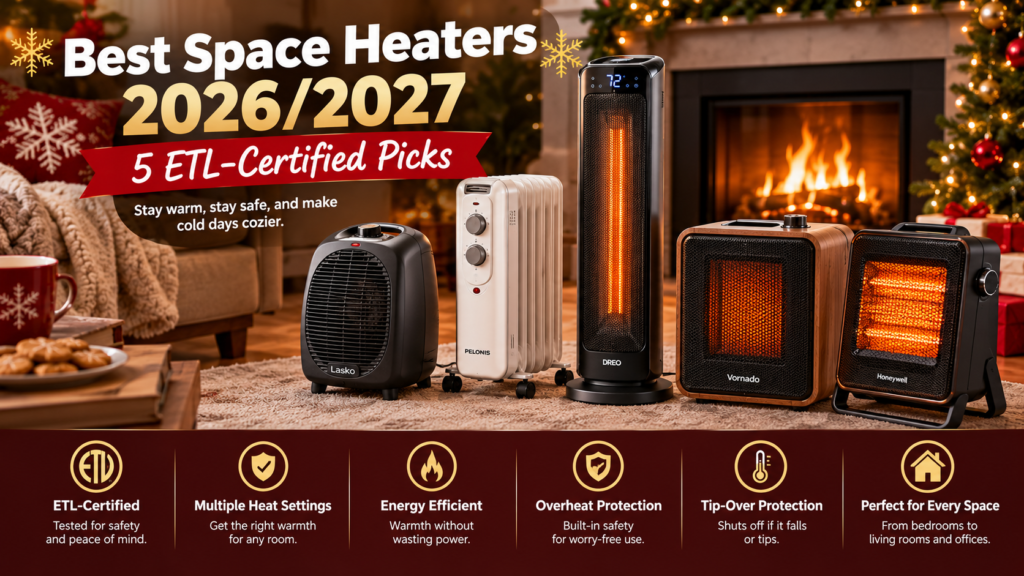
Let’s start with the rule that built this guide, because with heaters it comes before everything else: every pick below is ETL-listed — independently safety-certified, with the certification traced to a named source for each model during our research. Popular, well-reviewed heaters were dropped from this list when their certification could not be tied to the exact model. That is a stricter bar than most roundups apply, and for a device whose entire job is making heat inside your home, it is the right bar. If a heater’s listing cannot say who certified it, do not buy it — full stop.
Within that safety frame, this is a genuinely useful category. US snow season runs November 2026 through February 2027, and a 1,500W space heater turns the one cold room — the home office, the room over the garage — into the warm room for a fraction of heating the whole house. The five picks span roughly $30 to $100, all inside this site’s usual band. A heater also makes a thoughtful Christmas gift for anyone in a drafty house — opened December 25, used the same night. Check the live price on Amazon.
The safety basics — read before the picks. Keep any space heater at least 3 feet from anything that can burn — curtains, bedding, furniture, paper, clothing. Run it on a hard, flat, level floor, never on a bed or thick rug. Plug it directly into a wall outlet — never a power strip or extension cord. Never leave a space heater running unattended, and do not sleep with a fan heater running beside the bed (the oil radiator in pick #5, used with its thermostat and clearances, is the calmer overnight option, and even it deserves the 3-foot rule). Choose models with tip-over and overheat protection, keep them away from water, and keep children and pets out of reach of the grille. These rules — not the brand — are what make a space heater safe.
Why go “smart” in 2026?
The smart upgrade in heaters is the thermostat, and it is not a small thing. A heater with a real, adjustable thermostat — the DREO and Vornado below set temperature in 1-degree steps — cycles to hold a room at a chosen temperature instead of blasting on high until you notice you are sweating, then freezing again when you switch it off. An ECO mode and a timer finish the thought: heat that manages itself within your safety rules.
The second smart shift is honesty about protection. Certification (ETL), tip-over switches, overheat shut-offs, cool-touch housings, and flame-retardant materials are all checkable facts — and this category’s listings do not always volunteer them. One pattern our research caught: two respected Lasko models specify overheat protection but do not name a tip-over switch. That does not make them bad heaters; it makes them heaters to use upright, on a hard floor, where they will not be knocked — as their pick sections below state plainly.
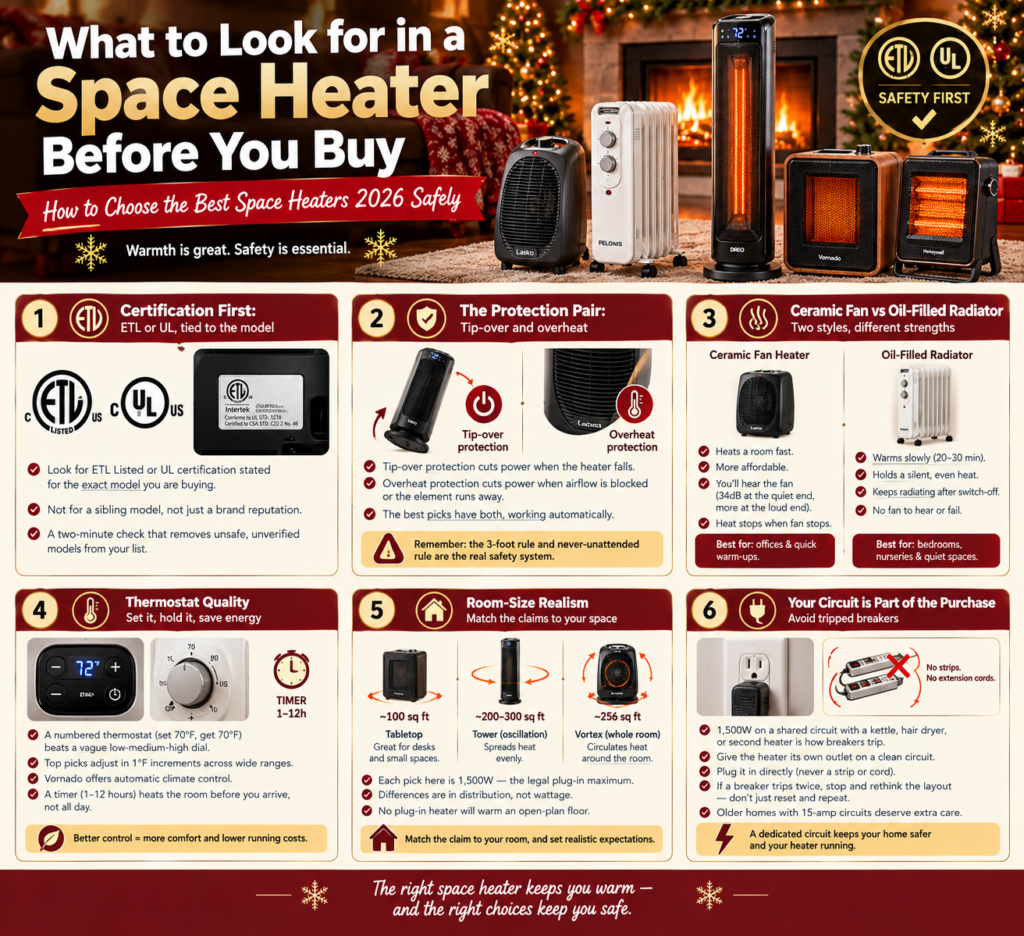
What to look for before you buy
1. Certification first: ETL or UL, tied to the model
Look for ETL Listed or UL certification stated for the exact model you are buying — not for a sibling model, not implied by a brand’s reputation. During this guide’s research, that single test removed several best-selling heaters whose paperwork could not be tied to their listing. It is a two-minute check that outranks every feature comparison below.
2. The protection pair: tip-over and overheat
Tip-over protection cuts power when the heater falls; overheat protection cuts it when airflow is blocked or the element runs away. The best picks have both, working automatically. If a model names only one — as the two Lasko picks here do — use it with that gap in mind: hard flat floor, stable spot, nothing that can topple it. And remember these are backstops; the 3-foot rule and never-unattended rule are the actual safety system.
3. Ceramic fan vs oil-filled radiator
Ceramic fan heaters warm a room fast and cost less; you hear the fan (34dB at the quiet end, more at the loud end) and the heat stops when the fan stops. Oil-filled radiators warm slowly — give them 20–30 minutes — then hold a silent, even heat, keep radiating after switch-off, and have no fan to hear or fail. Bedrooms and nurseries lean oil; offices and quick warm-ups lean ceramic.
4. Thermostat quality
A numbered thermostat (set 70°F, get 70°F) beats a vague low-medium-high dial for both comfort and running cost. The two best picks here adjust in 1°F increments across wide ranges, and the Vornado goes further with automatic climate control that varies heat and fan to hold the set point. A timer (1–12 hours across these picks) is the other half of sane running: heat the room before you arrive, not all day.
5. Room-size realism
A 1,500W heater is a 1,500W heater — the legal plug-in maximum — and every pick here is one. Differences are in distribution: a tower oscillates to spread heat, the Vornado’s vortex design circulates it around a whole room (rated toward ~256 sq ft), a tabletop model honestly covers about 100 sq ft around a desk. Match the claim to your room, and do not expect any plug-in heater to warm an open-plan floor.
6. Your circuit is part of the purchase
1,500W on a shared circuit with a kettle, hair dryer, or second heater is how breakers trip. Give a heater its own outlet on a circuit that is not already busy, plug it in directly (never a strip or cord), and if a breaker trips twice, that is information — stop and rethink the layout, do not just reset and repeat. Older homes with 15-amp circuits deserve extra care here.
Our top 5 picks for 2026
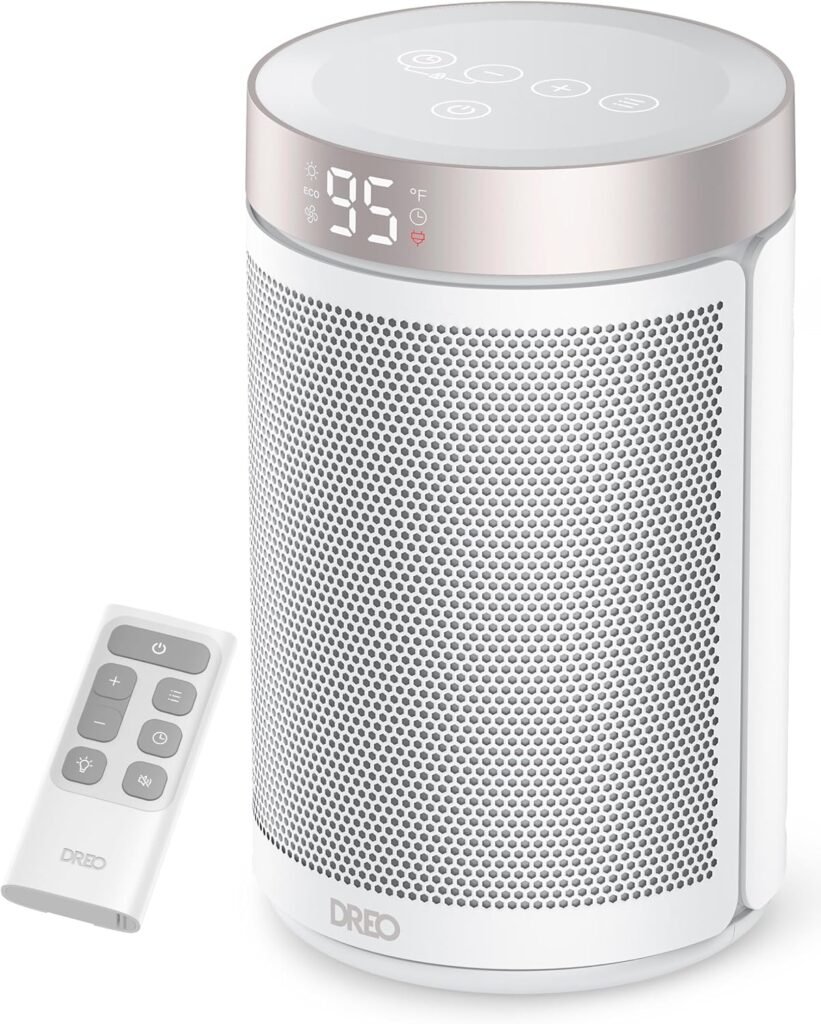
1. DREO Space Heater (DR-HSH006) — Best Overall
ASIN: B0C6FFK1GV
The DREO is what a modern ceramic heater should look like. Its 1,500W PTC ceramic element is governed by a thermostat adjustable from 41–95°F in single-degree steps, with ECO and Fan Only modes, a remote, a 12-hour timer, and a child lock — and it runs as quietly as 34dB, low enough for a desk or a bedroom corner. On safety, its listing states the full package: tip-over tilt detection, V0 flame-retardant materials, overheat protection, and a safety plug — all certified by ETL, in the listing’s own words. Price trackers score it 9.2/10 across more than 21,000 tracked reviews.
It typically sells around $40, which makes the spec sheet mildly absurd — this is the cheapest fully-featured heater in this guide and the best, which is why it leads. Honest notes: it is still a fan heater, so the heat is directional rather than room-filling, and 1,500W rules apply — its own outlet, hard floor, 3 feet of clearance, and off when you leave. Within those rules, it is the easiest recommendation here. Check the live price on Amazon.
Pros:
– Full protection set, ETL certified in its own listing text
– 1°F-step thermostat, ECO mode, remote, 12H timer
– Quiet at 34dB — desk and bedroom friendly
– Around $40 — the value of the guide
Cons:
– Directional fan heat, not whole-room circulation
– One room at a time — it will not heat a floor
– Needs its own circuit headroom like every 1,500W heater
Best for: Most people — the default heater for offices, bedrooms, and cold corners.
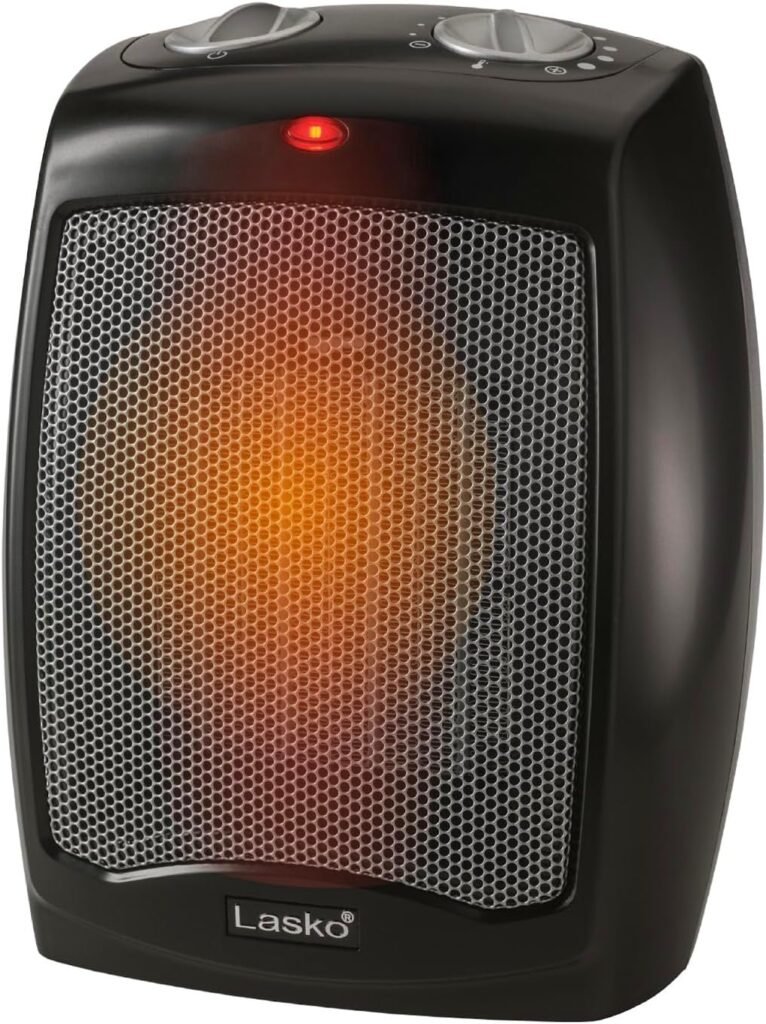
2. Lasko Ceramic Adjustable Thermostat Tabletop Heater (CD09250) — Best Budget
ASIN: B0735MVY4Y
Lasko’s little tabletop heater is the budget institution of this category: 1,500W high / 900W low plus a fan-only mode, an adjustable thermostat with manual controls, a carry handle, and a 9-inch footprint that fits a desk or a small table — about 100 sq ft of honest coverage at under 3 pounds. It is ETL Listed, with overheat protection, a self-regulating ceramic element, and a cool-touch housing stated in its listing text, backed by a 3-year limited warranty. It typically sells around $30.
Now the caution this pick requires, in plain words: its listing does not specify a tip-over switch. Protection here is overheat-based. Used as it should be — upright, on a hard flat surface, in a spot where it will not be knocked off a table edge — that is an acceptable, documented trade for the price. Used on a wobbly stool in a toddler’s play path, it is the wrong heater; buy pick #1 instead. We would rather print that than let you discover it. Check the live price on Amazon.
Pros:
– Around $30 — the cheapest certified heat here
– ETL Listed with overheat protection and cool-touch housing
– Tiny, light, with a carry handle — desk to room to room
– 3-year limited warranty
Cons:
– No tip-over switch specified — stable placement matters
– Manual dial thermostat, no remote or timer
– Covers ~100 sq ft — a personal-zone heater
Best for: Desks, dorms, and one cold workspace on a budget.
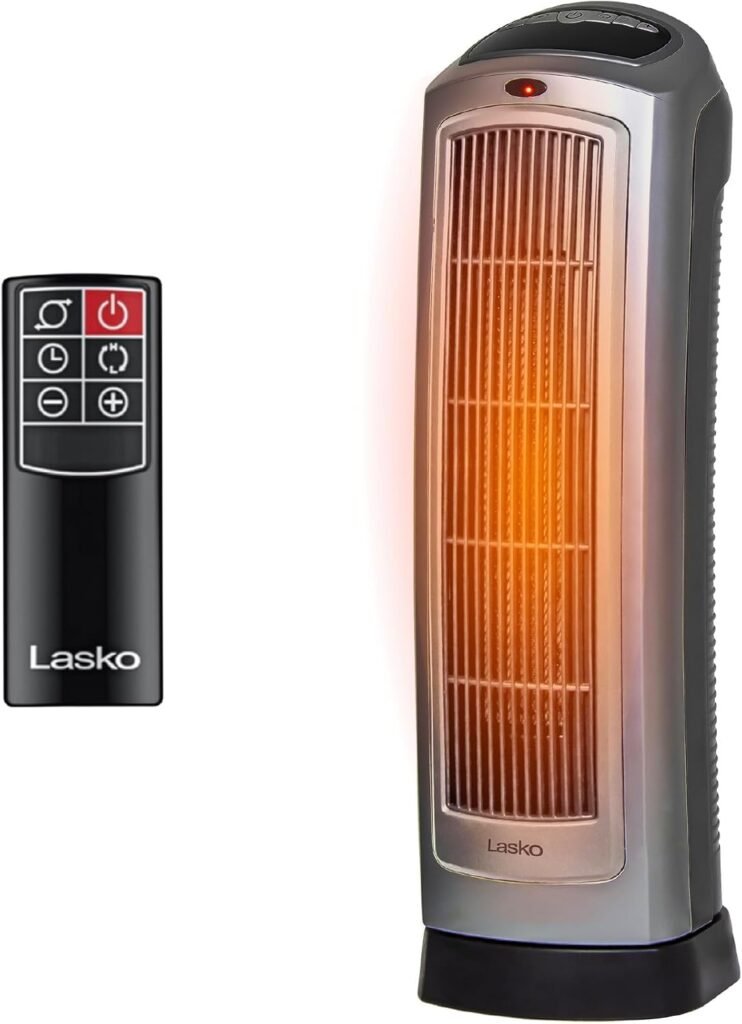
3. Lasko Oscillating Digital Ceramic Tower Heater (755320) — Best Tower for Larger Rooms
ASIN: B000TTV2QS
Some products earn their place by surviving: this 23-inch Lasko tower has been a default big-room answer for years, with ratings around 4.4 stars across more than 32,000 owner reviews. The format is the point — a tall ceramic tower on an oscillating base spreads 1,500W across a living room instead of drilling a hot line through it, with two quiet heat settings, a digital adjustable thermostat, a remote, and a 1–8 hour auto-off timer. It is ETL listed, with overheat protection and a cool-touch exterior stated in its listing. It typically sells in the high-$50s.
The same honesty as pick #2 applies, and independent testing makes it concrete: TechGearLab’s testing found no tip-over protection on this model — its protection is overheat-based. Lasko does not claim otherwise. So place it like a tower should be placed: flat floor, against a wall, out of traffic and out of tail-and-toddler range, with its 3 feet of clearance. In a calm living room, that is easy; in a chaotic playroom, choose pick #4, which passed tip-over testing outright. Check the live price on Amazon.
Pros:
– Oscillation spreads heat across larger rooms
– Digital thermostat, remote, 1–8H auto-off timer
– ETL listed; overheat protection; cool-touch exterior
– Enormous owner base — 32,000+ reviews at ~4.4 stars
Cons:
– No tip-over protection found in independent testing
– Tower footprint needs a stable, traffic-free spot
– Fan noise on high, like all ceramic towers
Best for: Living rooms and open spaces — placed carefully.
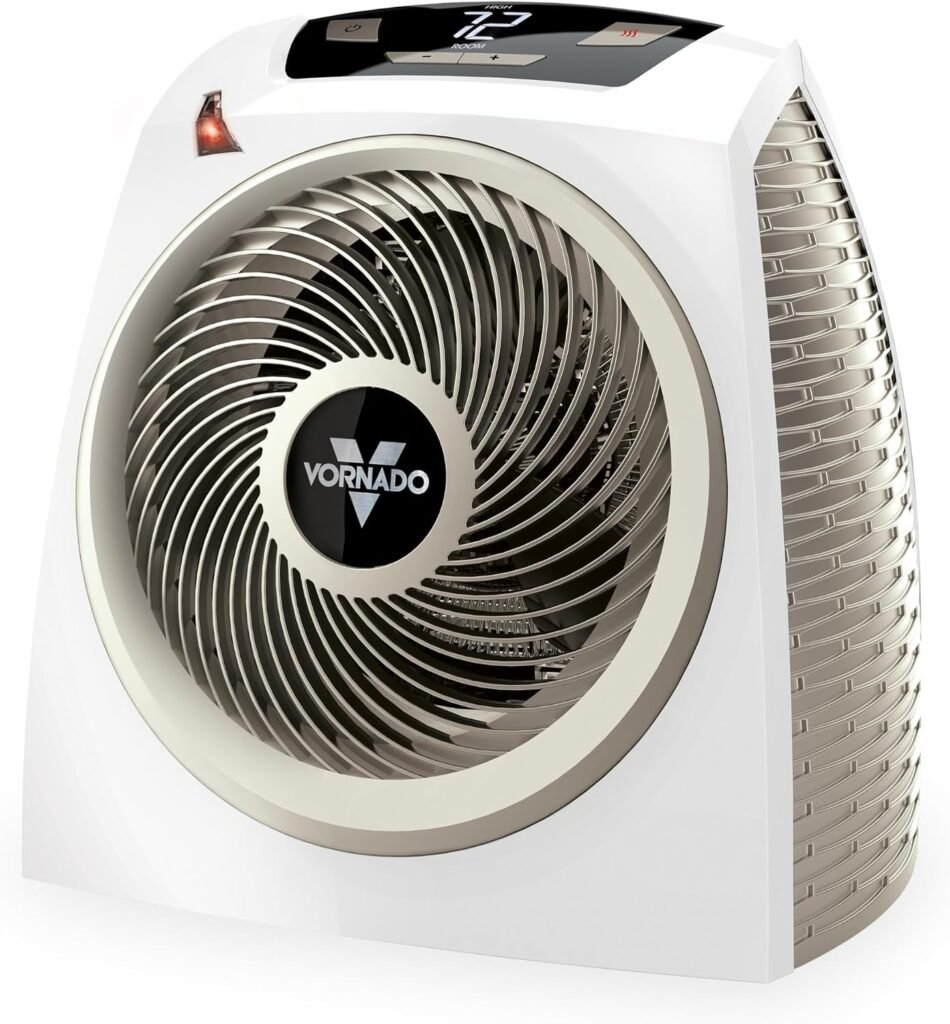
4. Vornado AVH10 Vortex Heater (AVH10) — Best Premium / Best for Whole-Room Even Heat
ASIN: B0FK5XX2VQ
The Vornado solves the complaint every other heater in this guide earns: one hot spot and a cold rest-of-room. Its vortex circulation moves heated air around the whole space — rated toward 256 sq ft — while Auto Climate Control continuously adjusts heat and fan output to hold your set temperature (60–90°F on its digital thermostat, with 1,500W/750W heat and a fan-only mode). It is ETL listed, and in independent testing its tip-over protection and overheat shut-off (tripping in about 10 seconds) both worked, with a cool-touch exterior — the most completely tested safety package here, under a 5-year warranty.
It typically sells right around $100, at the ceiling of our guide band — kept as the premium pick, with nothing pricier used above it. Owner ratings on retail mirrors run about 4.4 stars, though from a smaller base (a few hundred) than the Lasko tower’s tens of thousands. What you are buying is evenness: no roasting chair and freezing sofa, and no walking over to nudge a dial every hour. For a main living space used all winter, that is worth the step up. Check the live price on Amazon.
Pros:
– Whole-room vortex circulation — the even-heat pick
– Auto Climate Control holds temperature automatically
– Tip-over + overheat verified in independent testing
– 5-year warranty; ETL listed
Cons:
– Right at the $100 band ceiling
– Smaller review base than the big Lasko models
– Circulation fan is audible, if gently
Best for: Main living rooms where even heat matters.

5. Amazon Basics Portable Oil Radiator Heater (NY1507-15K) — Best Oil-Filled / Best Silent for Bedrooms
ASIN: B07HG923KN
The oil radiator is the heater for people who hate heater noise. Seven oil-filled steel fins warm up and radiate in complete silence — no fan, no hum, nothing — across three settings (1,500W / 1,000W / 600W) under an adjustable thermostat, covering up to about 144 sq ft. The oil keeps radiating after the element cycles off, which smooths the temperature swings fan heaters produce. Its title carries the certification plainly: ETL certified safety features, including tip-over protection and overheat protection. Owners rate it about 4.3 stars across roughly 3,400 reviews. Casters and a handle make its 25-inch frame easy to reposition.
It typically sells in the low-$70s. The trade is speed: give it 20–30 minutes to come up to temperature, where a ceramic fan is warm in two. That makes it the planner’s heater — switch it on before bed, let the thermostat hold the room overnight with the clearances respected — and the natural pick for light sleepers, nurseries (placed well out of reach), and anyone whose home office shares a wall with a sleeping baby. Silent, steady, certified. Check the live price on Amazon.
Pros:
– Completely silent — no fan at all
– ETL certified with tip-over and overheat protection stated
– Heat persists after the element cycles — even overnight warmth
– Three power settings for milder days
Cons:
– Slow to warm up — 20–30 minutes to feel it fully
– Bulky and warm to the touch at the fins; needs its clearances
– No remote or digital thermostat at this price
Best for: Bedrooms and nurseries — silent overnight warmth.
Side-by-side comparison
[IMAGE: comparison — ceramic tabletop heater, tower heater and oil radiator side by side | alt: “best space heaters 2026 comparison of top 5 picks”]
| Model | Type | Key spec | Best for |
|---|---|---|---|
| DREO DR-HSH006 | Ceramic fan, tabletop | 1,500W, 41–95°F thermostat, ETL full protection | Best overall |
| Lasko CD09250 | Ceramic fan, tabletop | 1,500/900W, ETL, no tip-over switch stated | Best budget |
| Lasko 755320 | Ceramic tower, oscillating | 1,500W, digital stat, ETL, overheat only | Best tower for larger rooms |
| Vornado AVH10 | Vortex whole-room | Auto Climate Control, ETL, tested tip-over | Best premium / even heat |
| Amazon Basics NY1507-15K | Oil-filled radiator | 7 fins, 3 settings, ETL tip-over + overheat | Best silent for bedrooms |
Who should skip these?
- If your home’s wiring is old and strained, fix the circuit question first. Five heaters will not help a panel that already trips with the kettle on.
- If you need to heat a whole house or a large open floor, that is a job for your central system or a contractor — no plug-in heater is built for it, and stacking several on one circuit is a genuine hazard.
- If a heater would run where you cannot keep 3 feet of clearance — a cramped dorm corner, a cluttered workshop — skip the purchase, not the rule.
- If you want set-and-forget heat while you are out, space heaters are the wrong product category. They are attended-room devices; all five picks assume a person in the house.
Frequently asked questions
Are space heaters safe to leave on overnight?
The honest answer is that space heaters are designed to run attended. Fire-safety guidance is consistent: never leave one running unattended, keep it 3 feet from anything that can burn, plug it directly into the wall, and use only models with certification plus tip-over and overheat protection. If a room must stay warm overnight, the oil-filled style (pick #5) — silent, no fan, thermostatically controlled, placed with full clearances and nothing within reach of the fins — is the calmest-risk way people do it. Fan heaters blasting beside a bed while you sleep is the pattern to avoid.
What does ETL certified mean?
ETL is a certification mark from Intertek, an independent testing laboratory — it means the product was tested to the applicable safety standard (the same standards framework as UL) and the factory is subject to follow-up inspections. For this guide it was the entry ticket: every pick is ETL-listed with the certification traced to the model’s own listing or documentation, and several popular heaters were dropped when that trace failed. Look for the mark and the model match, not just a brand you recognize.
Ceramic or oil-filled — which is better?
Ceramic fan heaters win on speed, price, and portability: warm air in a couple of minutes, lighter to move, cheaper to buy. Oil-filled radiators win on silence and steadiness: no fan noise at all, gentler temperature swings, and heat that persists after the element cycles off — at the cost of a slow warm-up and a bulky frame. Offices and quick warm-ups usually land ceramic; bedrooms usually land oil. This guide’s picks #1–4 are ceramic, pick #5 is the oil option.
How much does a space heater cost to run?
A 1,500W heater on high uses 1.5 kWh per hour — at a typical US residential rate, roughly 20–25 cents’ worth. Real use is lower: a thermostat cycles the element, and the lower settings on several picks exist for milder days. The economic case is heating the one room you are in instead of the whole house — that is where a space heater pays.
Why does my heater trip the breaker?
Because 1,500W is most of a 15-amp circuit by itself. Add a kettle, microwave, hair dryer, or a second heater on the same circuit and the breaker does its job. The fixes are layout, not force: one heater per circuit where you can, nothing else hungry on that circuit while it runs, and never solve it with a power strip or extension cord — a heater must plug directly into the wall outlet. Repeated tripping with nothing else running is a wiring question for an electrician.
How far from furniture should a heater be?
Three feet, minimum, from anything that can burn — bedding, curtains, upholstered furniture, clothing, paper — and that includes above and behind, not just in front. Place it on a hard, flat floor, out of walkways where it can be knocked or tripped over (a special note for the two picks here whose listings do not name a tip-over switch), and away from sinks, tubs, and any splash zone.
Which heater is best for a bedroom?
For most bedrooms, the oil radiator (pick #5): silent, steady, ETL certified with tip-over and overheat protection stated, and no fan cycling through the night. If you only need to take the chill off before bed and will switch off as you sleep, the DREO (pick #1) warms the room faster and its 34dB fan is quiet enough for the wind-down hour. Either way: hard floor, 3 feet of clearance, nothing draped anywhere near it.
The bottom line
[IMAGE: bottom-line — family living room warm and lamplit while snow falls outside the window | alt: “a warm home on very cold days with the best space heaters 2026”]
Buy the DREO DR-HSH006 for almost any single room — it is the complete package at a budget price. Buy the Lasko CD09250 for a desk on a strict budget, knowing its protection is overheat-only. Buy the Lasko 755320 tower for a bigger living room, placed with the same knowledge. Buy the Vornado AVH10 when even, whole-room heat is worth the premium, and the Amazon Basics oil radiator when silence and overnight steadiness matter most. And hold the guide’s rule above all of them: ETL-listed, 3 feet of clearance, plugged into the wall, never left running unattended.
Snow season runs November 2026 through February 2027, and Christmas is Friday, December 25, 2026. Check the live prices on Amazon, order before the first cold snap empties the shelf, and be warm on the very cold days — safely.